
Rutherford County Court Records After Arrest
After a Rutherford County jail arrest, two records tracks start to matter. The Rutherford County Detention Center handles the booking side, including intake, custody status, bond, holds, and release. The court side starts when a criminal case is opened through a charge, warrant, citation, summons, prosecutor filing, or indictment. A sheriff media release may show the arrest reason in short form, but that wording is not always the same wording that appears in the later court record.
The local court office is the Rutherford County Clerk of Superior Court. The county court page identifies Steve H. Owens as Clerk of Superior Court and lists the clerk office at 229 N Main St, Suite 203, Rutherfordton, NC 28139. The office phone is 828-288-6100, and published hours are 8:30 a.m.-5:00 p.m. Clerk staff handle administrative and record-keeping functions for District and Superior Court, but they cannot practice law or give legal advice.
For custody and booking detail, use Rutherford County jail inmate records. For booking photos, use the Rutherford County jail mugshots page. Court records after a jail arrest are about charges, case numbers, court dates, prosecutor action, and dispositions.
Search Rutherford County Court Records
The NC eCourts Portal is the online route for case information in Rutherford County after North Carolina moved eCourts statewide across all counties on October 13, 2025. The North Carolina Judicial Branch Rutherford County page also links to court dates, calendars, forms, payment information, and local court services. Portal data is useful for case lookup, but the Judicial Branch directs people doing background checks to the clerk's office.
The public terminal route is still important. Judicial Branch guidance says criminal case records can be searched at public self-service terminals in clerk offices. Those terminal searches can use defendant name, case number, or victim or witness name. Paper files are accessed through the clerk in the county where the case is located, and copies may require a fee.
| Search channel | Field or method | Use for Rutherford County |
|---|---|---|
| NC eCourts Portal | Dynamic case search and payment portal | Online case information after the case is entered. |
| Clerk terminal | Defendant name | Useful when the case number is not known. |
| Clerk terminal | Case number | Best when a citation, warrant, or file number is already known. |
| Clerk terminal | Victim or witness name | Supported by Judicial Branch guidance for criminal case searches. |
| Court date search | Name, citation number, county, and related filters | Useful for upcoming hearing checks, not a full booking record. |
The official North Carolina court-records guidance separates online case information from clerk file access. That distinction matters after a jail arrest because the jail may know current custody faster than the court portal, while the court file becomes the better source once charges, hearings, and orders are entered.
Find Court Records After Booking
A practical Rutherford County search starts with the clearest known fact. That may be the full legal name, arrest date, bond text from a sheriff media release, a citation number, or a warrant number. Spelling and date range matter because court records and jail records may not update at the same pace.
- Start with the arrest facts. Save the name spelling, arrest date, arresting agency if known, and any charge or bond wording.
- Check current custody through detention processing when immediate jail status is the main issue.
- Search the NC eCourts Portal after enough time has passed for a case entry.
- Use the Rutherford County Clerk of Court terminal or clerk file access if Portal does not show the case.
- Ask the clerk for official copies when a filed document, order, or disposition is needed.
- Expect limits for juvenile, sealed, expunged, or restricted records.
The county Clerk of Court page is a useful source for local court contacts. The screenshot below shows the local court contact page with the clerk, district attorney, magistrate, address, and office-hour details that help route court-records-after-arrest questions.
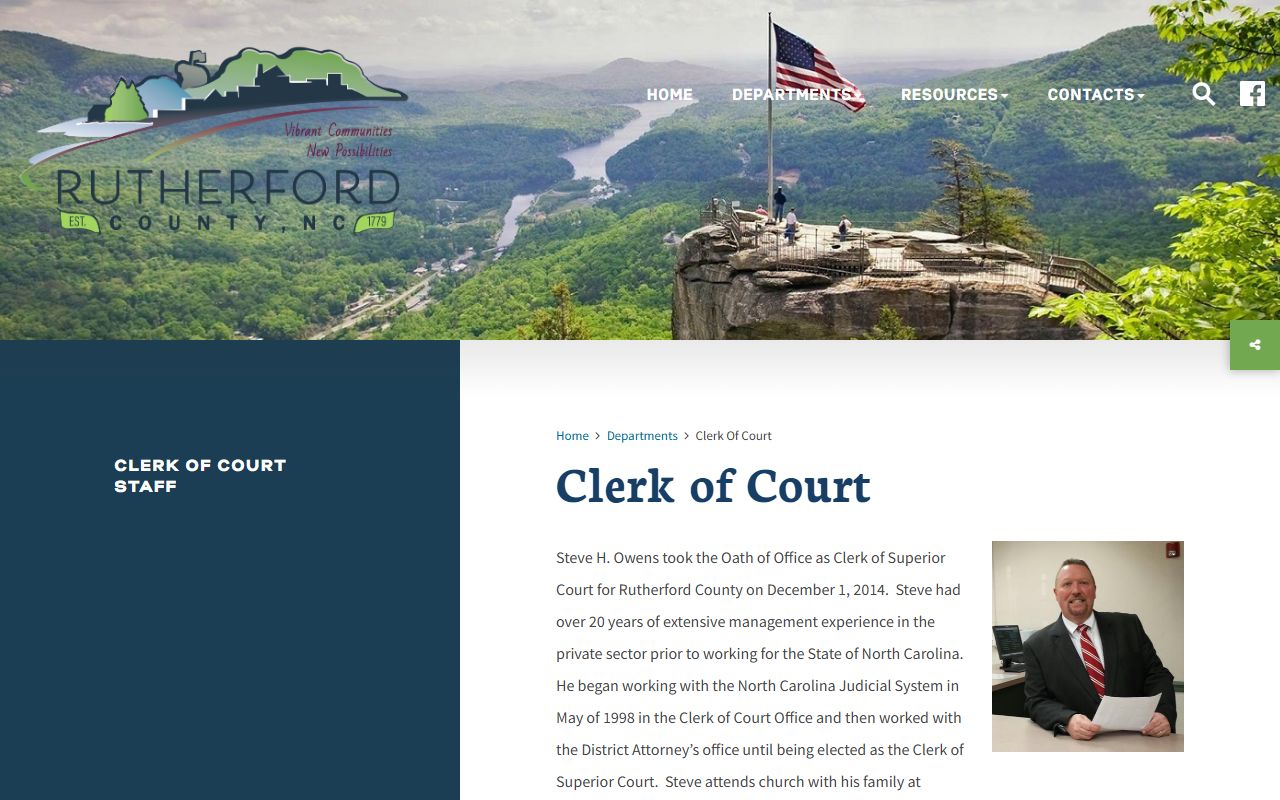
Use the clerk information for filed court records. Use detention processing for booking and custody questions that have not yet reached the court file.
Rutherford County Charging Documents
Charging documents explain why a criminal case exists. In North Carolina, a charge may start through a complaint, warrant, citation, criminal summons, information, or indictment depending on the offense and stage. An officer's arrest charge can be reviewed, changed, or replaced as the prosecutor and court process the case. District Attorney Ted Bell is listed for Prosecutorial District 41, and the district attorney's office prosecutes criminal cases after the arrest and filing stage.
| Document | Who uses it | What it can mean after arrest |
|---|---|---|
| Complaint, warrant, citation, or summons | Law enforcement or judicial process | May start the case or bring the person before court after alleged conduct. |
| Information | Prosecutor | May reflect the prosecutor's formal charge choice in a case that proceeds without indictment. |
| Indictment | Grand jury process | Often tied to felony procedure and Superior Court processing after review. |
A charging document is not a conviction. It is an accusation or formal case step. The case may later be dismissed, amended, reduced, bound over, indicted, pled, tried, or disposed. The final court record may look different from the arrest summary that first appeared in a sheriff release.
Rutherford County Charge Status
Charge status is the bridge between the arrest event and the final court result. A pending charge means the case has not reached final disposition. An amended or reduced charge means the filed charge has changed. A dismissal means that charge did not continue to conviction. A plea or trial result may create a conviction if the court accepts a guilty plea or enters a guilty verdict.
| Status | Plain meaning | Record caution |
|---|---|---|
| Pending | The case or charge remains open. | Do not treat it as a conviction. |
| Amended | The charge language or level changed. | Compare the current court entry with the original arrest wording. |
| Reduced | The case moved to a lesser charge. | The original booking charge may remain visible in older sources. |
| Dismissed | The charge did not proceed to conviction. | Expunction may be a separate legal process. |
| Disposed | The court has entered an outcome. | Read the exact disposition and any sentence or order. |
Note: A court record should be read by charge, not just by the defendant name, because one case can contain more than one count.
Bond After Rutherford County Arrest
Bond and release records often appear before the full court file is easy to find. Rutherford County research found bond details in sheriff media releases, including secured-bond and no-bond examples. North Carolina pretrial release is governed by G.S. 15A-534, which includes written promises to appear, custody release, unsecured bond, secured bond, and house arrest with electronic monitoring when ordered and lawful.
Magistrate processing is local and time-sensitive. The county court page lists magistrates at 828-288-6119, with hours of 8:30 a.m.-4:00 p.m. at the courthouse and 4:00 p.m.-8:30 a.m. at Rutherford County Jail. For bond payment methods, holds, or no-bond restrictions, the safest route is to verify with detention processing, the magistrate, the clerk, or a licensed North Carolina attorney. No official Rutherford County page located a complete public payment-method schedule for bonds.
| Release term | What it means |
|---|---|
| Written promise | The person signs a promise to appear without posting money first. |
| Unsecured bond | No upfront bond is paid, but money may be owed after a violation. |
| Secured bond | Money, property, or a surety is required before release. |
| No bond or hold | Release is blocked until a court or agency condition is cleared. |
Warrants and Court Records
No official Rutherford County active-warrant search database was located on the sheriff website. The sheriff staff directory identifies Lieutenant James Hoppes as the warrants contact, phone (828)-287-6152. North Carolina G.S. 15A-304 governs arrest warrants, and warrants or orders for arrest may lead to a jail booking and then a court case record.
Failure-to-appear arrests also matter in Rutherford County because sheriff media releases use FTA language in arrest summaries. If the concern is an open court order, use the clerk, NC eCourts Portal, or the warrants contact. If the person has already been arrested, detention processing at (828)-287-6160 is the more direct channel for current custody.
Charges, Convictions, Sealed Records
Two comparisons prevent the most common record mistake after a Rutherford County jail arrest. First, a charge is not the same as a conviction. Second, a sealed record is not the same as an expunged record. North Carolina Judicial Branch material on expunctions identifies statutes including G.S. 15A-145.5 and G.S. 15A-146, but eligibility depends on the exact case history and disposition.
| Point | Charge | Conviction |
|---|---|---|
| What it is | An accusation or filed count. | A guilty plea, guilty verdict, or equivalent final result. |
| When it appears | After arrest, citation, warrant, summons, filing, or indictment. | After plea, trial, or other final adjudication. |
| How to read it | Check whether it is pending, amended, reduced, or dismissed. | Read the sentence, conditions, and final disposition. |
| Point | Sealed | Expunged |
|---|---|---|
| Public access | Hidden or restricted from ordinary public view. | Removed from ordinary public access if the court grants relief. |
| Legal effect | Access limits remain defined by the order and law. | The record may be treated as cleared for many public purposes. |
| Rutherford County route | Ask the clerk about the file status, but do not expect legal advice. | Review North Carolina expunction law and consult counsel if needed. |
Restricted Rutherford Court Records
North Carolina public access is broad, but it has limits. G.S. 132-1 defines public records broadly, while G.S. 132-1.4 limits criminal investigation and intelligence records. Court files can also be affected by juvenile confidentiality, sealed orders, expunctions, victim privacy, medical information, and security concerns.
Background-check use has a separate warning. Portal searches and casual lookups are not the same as a formal background check. Judicial Branch guidance says background checks should go through the clerk's office. A private site or general search result should not be used for credit, employment, housing, insurance, or other Fair Credit Reporting Act purposes.
Important: Verify official status with the clerk, court file, prosecutor, or originating agency before relying on a Rutherford County charge record.